You're A Leader. You Should Claim Your Influence. Let Climate Be Your Catalyst.

Folks who’ve followed me since my early “marketing to women” days (What? You didn’t know I co-authored a book on that?) have watched as my work moved into leadership and then fully integrated the climate focus. As such, they’ll have almost heard me yelling about the untapped power of leadership climate influence for the past three years, especially. Well, I’ve settled in, as evidenced by this newsletter, my Living Change climate leadership podcast, and what you see me sharing on platforms like Tw/X, LinkedIn and now (I’m liking it!), BlueSky.
The thinking for this post is a part of the bones of a book I’ve started outlining, so stay tuned and I’ll keep it shorter here.
First, I was doing some research on the idea of reputation management, which seems to be the phrase corporate public affairs teams are zeroing in on now (especially in the sustainability and climate spheres). From Wikipedia:
Reputation management, originally a public relations term, refers to the influencing, controlling, enhancing, or concealing of an individual's or group's reputation.
I hooked onto the term “influencing" as I am known to do. Then, I came across old Twitter friend Ron Carucci’s HBR piece, Building Your Reputation As A Trustworthy Leader, where a few of his key points caught my eye as they 100% align with my own Theory of Change. His points:
-Be who you say you are.
-Embody your stated values.
-Build bridges that unify.
From there, I ventured to other experts on influence and came across a TEDxTalk by Teresa de Grosbois, where she talked about two things I’ve noticed in my own advising work:
That people stop themselves from claiming their influence (but sociopaths do not, as those of us observing horrific global politics can attest).
And, that, giving influence to another person is how you become more influential (do I need to repeat that for emphasis, folks? I.E. #NameAndFame and “love up” others in your sphere).
Then - alongside Carucci and de Grosbois, I put my own long-standing Manifesto and Theory of Change . It seems to run counter to any process my clients or listeners have otherwise come across:
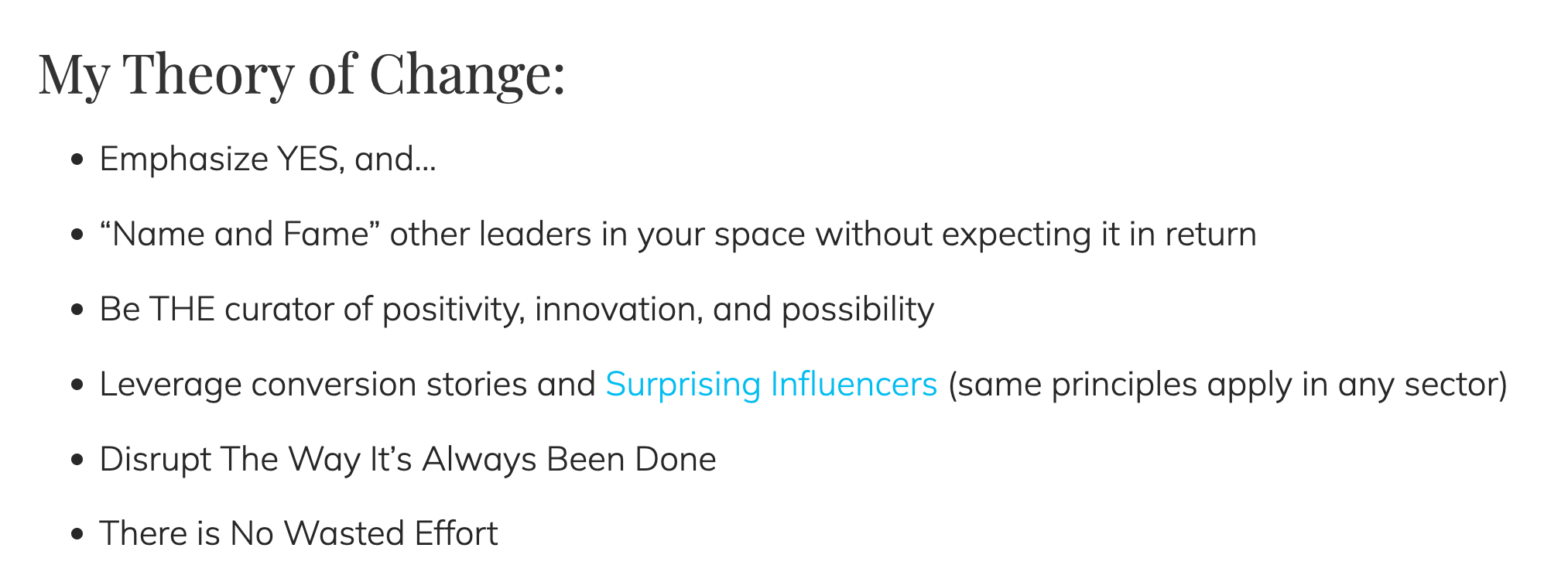
No matter how influential a leader’s role or how impressive they look from a LinkedIn or Google search, they often still hesitate to start writing, posting, ENGAGING, and saying things on stages or podcasts that point to their own part in the leadership they represent.
And, lots of leaders resist another of my calls, to elevate and amplify others with no direct agenda, because they assume it’ll appear transactional.
Yet, when all of this is done from an authentic place, where you yourself have been public about being on the journey and have started to more boldly walk your talk, it will land very well. Just ask a client of mine who recently and quickly upped her leadership influence around climate policy.
I could go on, but I’ll refer to the title of this issue to close:
You’re a leader.
You should claim your influence.
Climate should be the best influence-building catalyst of our time.
(Are you ready to GO?)
News To Use
Behavioral crisis research that speaks my climate influence-call language, via Joseph J. Merz et. al. in Sage Journals/Science Progress: World scientists’ warning: The behavioural crisis driving ecological overshoot
In the final sections of this paper, we propose an interdisciplinary emergency response to the behavioural crisis by, amongst other things, the shifting of social norms relating to reproduction, consumption and waste. We seek to highlight a critical disconnect that is an ongoing societal gulf in communication between those that know such as scientists working within limits to growth, and those members of the citizenry, largely influenced by social scientists and industry, that must act.
My takeaway: I’d highlight the phrases/words from this: the shifting of social norms, critical disconnect, and societal gulf in communication. If a behavioral crisis is driving ecological overshoot (aka - in my mind - climate change horrors), why do we just keep trying the same behavioral shift methods rather than upping our strategy to look at who influences the influencers and how we can much more intentionally tap THAT?
***
SEO and Social Media practices that align with building a leadership brand, via Rocky Parker of Beyond Bylines.
This is where social media does matter to SEO. It does for companies, users, and organizations what SEO does for well-written webpages with clear information: it drives engagement and visibility. If an organization is a frequent and consistent poster on X, for example, it's developing brand recognition. The next time a user makes a search query relating to that organization’s focus, they’re more likely to select search results from that organization. Pages being consistently visited and shared by social media users will reflect on a site’s traffic, in turn improving their overall SEO ranking.
In addition to boosting brand recognition, a strong social media presence can extend the life of your content and build a stronger reputation for your outlet or personal brand.
My context: If you pen an occasional post or your communications team posts the occasional video of you, having steadily been on whatever social platform means you have the social capital to make the most of it. Perhaps you focus on doing less, but better, content, and then find gazillions of ways to re-package, re-post and re-activate at key moments. When you have an audience for something (which you only get by being somewhat active on a social platform ), it DOES help SEO and all sorts of things you may not have thought about.
***
A fantastic, real-time California climate influence example via Debra Kahn in Politico.
A top California transportation official who was reassigned last month told POLITICO she was demoted for objecting to highway expansions that will increase driving.
Jeanie Ward-Waller, Caltrans’ deputy director of planning and modal programs, was taken off the job in September. Her reassignment came three weeks after she said she notified agency officials that she would file a whistleblower complaint about Sacramento-area road construction projects allegedly circumventing environmental rules.
My context: To nudge organizations like CalTrans to take climate-aware leadership like Ward-Waller’s seriously, we can all “name and fame” such media coverage (thanks Politico!). We should also be cheering on Jeanie (and any other leader doing such climate-acting whistle-blowing) from all angles - to support her in what must feel pretty lonely in the moment. She did the right thing. She’s leveraged her climate influence at 10x scale.
***
I’ve gotten a lot of positive feedback about how the The Brainy Business podcast interview with me was super helpful for understanding how climate influence works and why it matters. That episode is now in my Living Change podcast feed, so you can subscribe and listen to that conversation, and then have that much more context for my interviews with political, cultural and corporate climate action influencers. I’d love to hear what you think ,and always appreciate ratings/reviews on Apple podcasts or Spotify.
***
I look forward to seeing some of you at GreenBiz VERGE23, where I’ll host a roundtable luncheon (that Thursday) on Climate Influence and moderate a closing session to synthesize the food theme learnings of the conference.

Thanks *so much* for reading/sharing/subscribing. Please comment or message me with questions on building climate influence. I may cover your suggested topics in a future issue. In the meantime, feel free to follow me on LinkedIn or BlueSky in the meantime (I also linger on “X”.)